Origins of Zoroastrianism & Royal Epigraphy
Examining the historical emergence of Zoroastrian thought through archaic Old Avestan linguistics, royal Achaemenid cuneiform monuments, and modern peer-reviewed scholarly consensus.
Eastern Iranian Plateau & Central Asia
Aria (Herat), Margiana, Bactria, and Sogdiana
c. 1200–1000 BCE (Oral Gathas)
Imperial epigraphic era c. 550–330 BCE
Zarathustra Spitama (Zaotar)
Achaemenid rulers: Cyrus the Great, Darius I, Xerxes I
The Avesta (17 Gathas & Yasna)
Trilingual Royal Epigraphs (Behistun, Persepolis, Naqsh-e Rostam)
Global Zoroastrian Communities
Parsi communities in India, Irani Zoroastrians & global diaspora
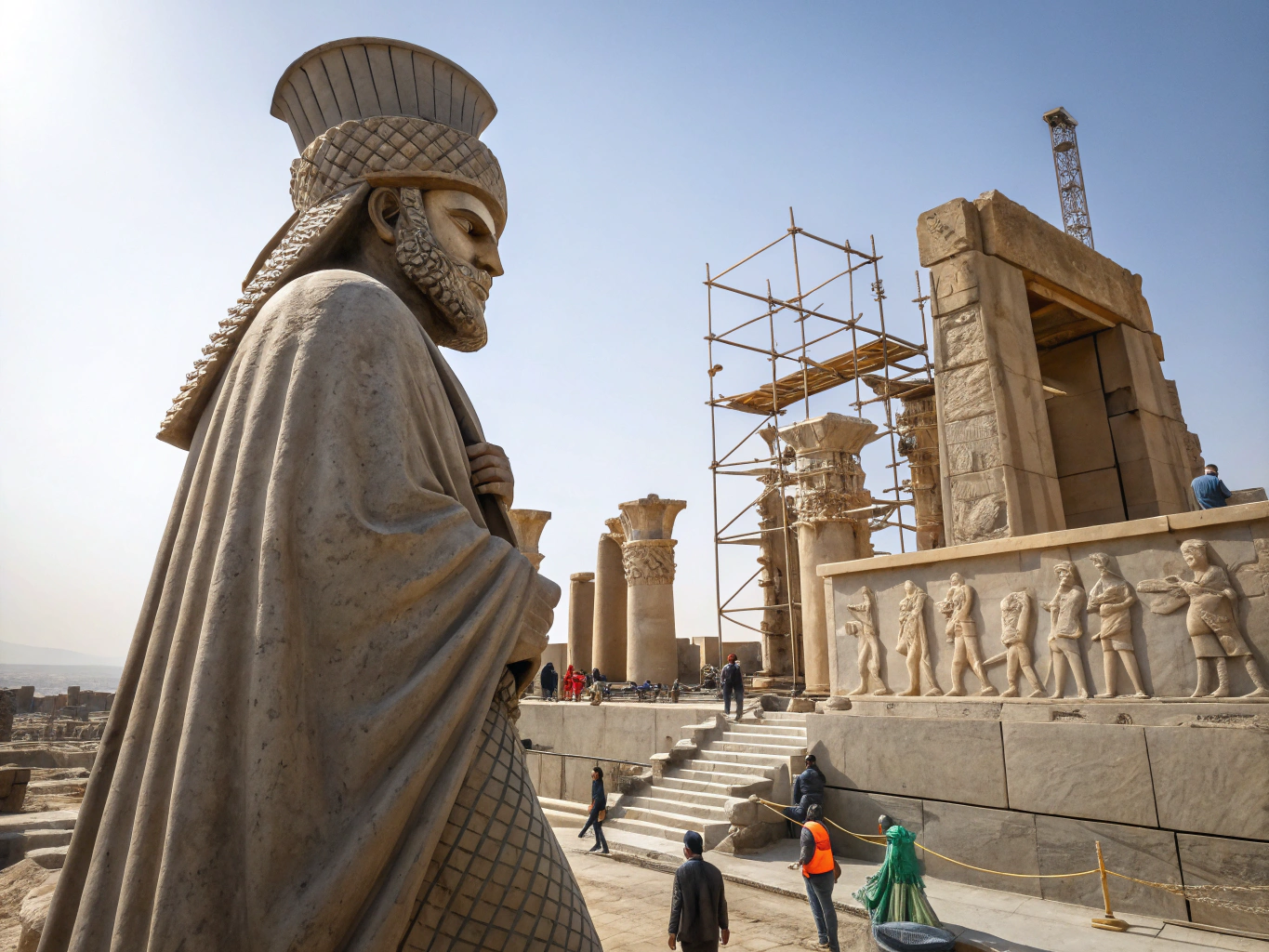
While the Gathas were orally transmitted across Eastern Iran and Central Asia in the 2nd millennium BCE, the earliest deciphered physical writings invoking Ahura Mazda appear in Western Iran on the cliff faces of Kermanshah and palaces of Persepolis under the Achaemenid dynasty (c. 550–330 BCE).
Royal inscriptions verify the imperial state cult of Ahura Mazda, whereas theological and ritual mechanics survive via the Avestan liturgical corpus.
Behistun Trilingual Inscription (DB)
c. 520–518 BCE (Achaemenid Empire)“Says Darius the King: By the favor of Auramazdā I am King; Auramazdā bestowed the kingdom upon me.”
The earliest securely dated imperial inscription invoking Ahura Mazda (Auramazdā). Darius attributes his reign and suppression of rebellions directly to divine divine order (Aša) against the cosmic Lie (Drauga).
Persepolis Foundation Inscriptions (DPd / DPe)
c. 515–490 BCE“May Auramazdā protect this country from the enemy army, from famine, and from the Lie (Drauga)!”
Crucial prayers protecting the realm against 'the Enemy, Famine, and the Lie (Drauga)'. Directly mirrors the Gathic dualism between Aša (truth) and Druj (deceit) and documents state grain allocations to Magian priests for Ahura Mazda sacrifices.
Naqsh-e Rostam Tomb Inscription (DNa)
c. 490 BCE“A great god is Auramazdā, who created this earth, who created yonder sky, who created man, who created happiness for man, who made Darius king.”
Provides the earliest formal imperial creed articulating Ahura Mazda as the cosmic creator of earth, celestial heavens, humankind, and earthly well-being/peace (šiyāti).
Xerxes I 'Daeva Inscription' (XPh)
c. 486–465 BCE“And among these countries was a place where previously false gods (daivā) were worshipped. By the favor of Auramazdā, I destroyed that sanctuary of the Daevas.”
Records the imperial prohibition of the worship of false/demonic gods (Daevas), explicitly aligning royal state policy with Zoroastrian theological dualism and ordering proper worship of Ahura Mazda with cosmic ritual order (artācā brazmaniya).
Cyrus Cylinder Inscription
c. 539 BCE“I gathered all their inhabitants and returned to them their dwellings… I returned the images of the gods to their sanctuaries.”
Demonstrates imperial Persian policy of religious tolerance and repatriation of displaced cults. While couched in Babylonian theology (Marduk), historians compare its ideological ethos with early Achaemenid justice and imperial Avestan parallels.
Old Avestan Gathas & Yasna Manuscripts
Oral composition c. 1200–1000 BCE; Extant Sasanian-tradition MSS dated 1323 CE“This I ask Thee, tell me truly, Lord: Who was the father of Order (Aša) at its beginning? Who set the sun and stars their paths?” (Yasna 44.3)
Preserves the 17 Gathas attributed directly to Zarathustra Spitama. Philological comparisons demonstrate exact grammatical morphology with Rigvedic Sanskrit, anchoring Zoroastrian origins to late 2nd millennium BCE Central Asian pastoral societies.
Scholarly Consensus & Academic Frontiers
Distinguishing established historical conclusions from active academic debates regarding Zoroastrian origins.
Comparative philologists (Kellens, Skjærvø, Hintze, and Kuiper) establish that Old Avestan is an archaic sister language to Rigvedic Sanskrit. The metric structure, pastoral terminology, absence of iron tools, and absence of western Iranian geography demonstrate the Gathas were composed in the late Bronze / early Iron Age (c. 1200–1000 BCE), centuries before the Achaemenid Empire.
Academic Bibliography & Primary Sources
Peer-reviewed monographs, epigraphic critical editions, and historical references for Zoroastrian origins.
A History of Zoroastrianism, Vol. I: The Early Period
Handbuch der Orientalistik, E.J. Brill, Leiden
The Spirit of Zoroastrianism
Yale University Press, New Haven & London
Monotheism in the Gathas and the Problem of the Dualism in Zoroastrianism
Journal of the Royal Asiatic Society, Cambridge University Press, 24(2), 225–249
The Old Persian Inscriptions of Naqsh-i Rustam and Persepolis (Corpus Inscriptionum Iranicarum)
School of Oriental and African Studies (SOAS), London
Essays on Zarathustra and Zoroastrianism (Trans. P.O. Skjærvø)
Peeters Publishers, Leuven & Paris
Die Religion Zarathustras: Geschichte, Gegenwart, Rituale (Band 1)
W. Kohlhammer Verlag, Stuttgart
Zoroastrianism & Ancient Iran
One of the world's oldest continuously practiced prophetic traditions, originating in ancient Eastern Iran and shaping imperial governance, moral dualism, and philosophical thought across Eurasia.
The Threefold Moral Mandate
Mental alignment with Asha (Truth); rejecting malicious and chaotic intentions before they manifest.
Significance: Identifies conscious intention as the sovereign locus of individual moral accountability.
Veracity, keeping oaths, constructive speech, and avoiding slander or deceptive declarations.
Significance: Stresses the cosmic sanctity of the sworn oath (mithra) and social consequences of untruthful utterance.
Active preservation of creation, charity, honest labor, caring for fire, water, and living things.
Significance: Mandates positive environmental stewardship, agricultural labor, and social justice as religious duties.
The Uncreated Spirit, Lord of Wisdom, representing cosmic order, truth, and primordial light.
Significance: Earliest theological hymns naming Ahura Mazda as the sole uncreated creator of physical (getig) and spiritual (menog) existence.
The fundamental conflict between Asha (truth, cosmic order, righteousness) and Druj (deceit, falsehood, entropy).
Significance: Formulates the foundational ethical dualism wherein humans choose actively between cosmic order and destructive deceit.
Six divine emanations of Ahura Mazda representing Good Purpose, Righteousness, Dominion, Devotion, Wholeness, and Immortality.
Significance: Defines the six primary beneficent archangels and guardians over the six creations (cattle, fire, metal, earth, water, plants).
Scholarly Consensus on Dualism
Scholarly InterpretationScholars distinguish between cosmic dualism (the eternal clash between the Spenta Mainyu/Ahura Mazda and Angra Mainyu/Ahriman) and eschatological monotheism (the ultimate triumph of Asha and transfiguration of the world during Frashokereti).
Scholarly Bibliography & Primary References
Zoroastrians: Their Religious Beliefs and Practices
London & Boston: Routledge & Kegan Paul
A History of Zoroastrianism, Volume II: Under the Achaemenians
Leiden: E.J. Brill
Traditions of the Magi: Zoroastrianism in Greek and Latin Literature
Leiden: Brill
Zoroaster's Time and Homeland: A Study on the Origins of Mazdeism and Related Problems
Naples: Istituto Universitario Orientale
The Gathas of Zarathushtra and the Other Old Avestan Texts (2 vols.)
Heidelberg: Carl Winter Universitätsverlag
The Spirit of Zoroastrianism
New Haven & London: Yale University Press
Die Religion Zarathushtras: Geschichte – Gegenwart – Rituale (3 vols.)
Stuttgart: W. Kohlhammer Verlag
Ancient Persia: From 550 BC to 650 AD
London & New York: I.B. Tauris
All doctrinal summaries adhere to the critical-historical method and peer-reviewed Iranian philological consensus.
View Full Central Reference IndexReligious History Timeline
Explore the origins and development of global traditions through historical evidence and scholarly consensus.
Emergence of organized pantheons and temple-based worship in the Fertile Crescent, marking the earliest recorded religious structures.
Cuneiform, Ziggurats, Oral Tradition
Earliest administrative and ritual cuneiform inscriptions recording allocations to the Eanna precinct of Inanna.
Development of the Vedas and early ritualistic practices that would eventually evolve into the diverse traditions of South Asia.
Sanskrit, Vedic Hymns, Rituals
Linguistic cognates shared between Vedic Sanskrit and Old Avestan, demonstrating common Proto-Indo-Iranian religious liturgy.
A period of profound transformation where Buddhism, Jainism, and Zoroastrianism emerged, emphasizing ethics and personal salvation.
Philosophy, Ethics, Early Texts
First royal epigraphic attestation of Ahura Mazda under Darius I, alongside the preserved Gathic hymns of Zarathushtra.
The rapid development and geographical expansion of early Christianity and the continued evolution of Rabbinic Judaism.
Manuscripts, Oral Law, Networks
Primary Hebrew, Aramaic, and Greek papyri illustrating Second Temple apocalyptic theology and early Christian scriptural transmission.
The emergence and rapid growth of Islam, fostering significant advancements in science, philosophy, and religious scholarship.
Arabic, Calligraphy, Theology
Critical radiocarbon-tested Quranic folios and Sasanian-era Zoroastrian theological defenses composed during the early Islamic centuries.
Scholarly Bibliography & Primary Sources
Peer-reviewed historiographical texts, epigraphic records, and comparative linguistic corpora supporting this chronological framework.
Explore Further
Dive deeper into our comprehensive database of religions, ancient civilizations, and scholarly evidence.